

John Carr and Sharen Bertrando offer strategies that are particularly successful with English learners and students with learning difficulties
At the core of our guidebook are a set of effective strategies that teachers can use regularly in classrooms that include English learners and students with learning difficulties.1 These strategies have been shown to be especially effective with these students because they provide scaffolding to help with language and with understanding concepts, and the interrelationships among concepts.
Six Effective, Practical Strategies for Scaffolding Learning
We assume that many teachers have some level of familiarity with most or all of the strategies we describe here. If a strategy is entirely new for a teacher, we encourage using other resource materials or experienced colleagues to learn more about its purpose and implementation. However, we purposefully selected strategies that are fairly quick and easy to learn. These are strategies that can be applied to teaching in any content area, can be integrated and embedded into doable differentiated lessons, and can be used frequently (even daily) in the classroom. Also, research and professional literature have identified these strategies as being effective with the general student population, English learners, and students with learning difficulties.2, 3, 4
Based on these criteria, the six strategies we recommend for scaffolding content are:
1. Visuals
2. Think-Pair-Share
3. KWL+
4. Cues
5. Think Aloud
6. Summarization
Visuals
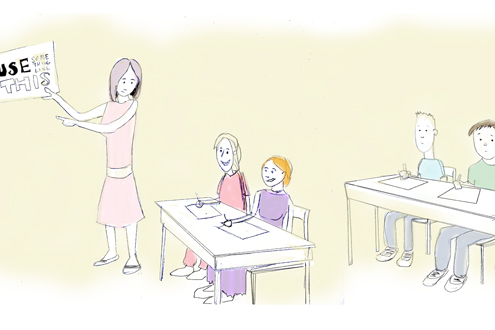
This strategy consists of using non-linguistic representations (such as photos, models, real objects) and spatial-linguistic representations (such as graphic organizers that contain terms or very brief text in a spatial organization) to visually represent ideas and relationships among ideas. Visuals are concrete representations that can be an important and effective addition to direct instruction – a teacher can scaffold his or her talking with visuals such as objects, videos, gestures, items, or terms on a chart or board that the teacher points to and, most important, graphic organizers. Physically modeling or demonstrating can also be classified as using visuals.
Think-Pair-Share
To use Think-Pair-Share, the teacher poses a challenging, open-ended question and gives students a brief time to think (usually from five seconds to one minute). Student pairs then discuss their ideas for one or more minutes. And lastly, pairs share ideas with a larger group or the whole class. Think-Write-Pair-Share is an adaptation in which students jot down their ideas before discussing with a partner; the writing step holds each student more accountable and the teacher can read responses while pairs are sharing, but it may need to be adapted for students who struggle just to compose a brief idea (e.g., students may be given the choice to write, illustrate, or record an idea). A graphic organizer can be used to help support this strategy, using four columns: “Question,” “What I thought,” “What my partner thought,” and “What we will share.” The Pair-Share steps can come after thinking, reading, or writing; in common are time for individuals to reflect or think critically followed by time for pairs/groups to rehearse and rephrase ideas and to practice social skills, such as active listening and disagreeing respectfully.
Think-Pair-Share is quick, encourages all students to participate, and encourages students to perform as experts (not just the teacher) by shifting some control for the learning process from the teacher to the student groups. Often the teacher will need to model the expected behaviors of group work (what students say and do) until students have internalized the rules of social learning. Collaborative grouping provides opportunities to teach social skills, academic discourse, and civics.
KWL+
This strategy consists of publicly recording students’ responses to questions about what they already know (K) and what they want (W) to know as they begin a new lesson, and then at the end of the lesson recording what students have learned (L). The “+” aspect of KWL+ refers to the final step of making connections among the three categories of information. KWL+ is a special type of graphic organizer.
Cues
Cues are advance organizers, hints, and prompting questions by the teacher.5 Advance organizers orient students to upcoming important content. Hints directly frame or preview the learning. Questions reinforce what has been taught and check for understanding.
The teacher uses cues, such as reflecting on a prior lesson or presenting an advance organizer at the beginning of a day’s lesson, to help students recall and start connecting to prior knowledge. During the lesson, and as part of checking for understanding, the teacher uses prompts to elicit more information or expand on an idea. The teacher guides student thinking with cues as questions or statements, particularly as an advance organizer during the engage stage of the lesson and when checking for understanding.
English learners may need more intensive cues to support their language skills while students with learning difficulties may need more intensive cues broken into mini-parts to support their cognitive processing.
Think Aloud
Using Think Aloud, the teacher verbalizes his or her own thought processes or models academic discourse, such as modeling how students should interact during group work. Think Aloud needs to be supported with visuals (e.g., pointing to parts of a graphic organizer displayed on the wall, indicating specific words or passages in the text) as the teacher gives students insight into what he or she is thinking while reading text. Before students start a small-group task, the teacher might need to model a thinking strategy, indicating appropriate ways to interact during small-group discussions. For Think Aloud to be effective, the teacher must make the purpose explicit and give students chances to practice the strategy to internalize it. There is a base of research on Think Aloud showing that it is particularly effective with English learners who also have learning difficulties.6
Summarization
This strategy can be as simple as the teacher summarizing important information at the conclusion of direct instruction or group work; but more often, the teacher should have students do the summarizing. When students complete a segment of active learning, for example, the teacher might ask them to summarize important information, which provides an opportunity for the teacher to check for understanding. In summarizing, students must comprehend and distill information into a parsimonious, synthesized form – in their own words.
Note taking is a form of summarization and may occur during teacher talk or while a group conducts a science experiment or concludes a discussion about a story, alternative mathematics strategies, or social events or historical persons.7 For English learners at early language development stages and for some students with learning difficulties and other struggling writers, one way to scaffold note taking is to give students the teacher’s notes as Sentence Frames with blanks where the students can write in key ideas. The teacher might differentiate by giving a mostly completed template to some students and a less completed template, which requires more writing, for the more proficient students. (Generally, students should not be given fully completed notes so they maintain an active role in the learning process and can practice summarization.) Completing Sentence Frames or writing with a keyboard (rather than having to write by hand) can support many students with learning difficulties, particularly students with Asperger Syndrome (part of autism spectrum disorder or ASD), who often have fine motor skill difficulties, and students with Attention Deficit Hyperactivity Disorder (ADHD) or a Specific Learning Difficulty (SLD), who typically have difficulty organizing thoughts, sequencing information, and identifying the main idea and details. Also, the teacher may need to chunk talking by stating limited new information and giving students with learning difficulties time to process and summarize it in notes, and then repeat the process for each chunk of information. This is a procedure that benefits all students, especially when introducing a new concept or integrating information.
When the teacher intersperses chunks of information with summarization activities, students can store much more information in long-term memory than when the teacher spends a long time providing information without giving breaks for students to summarize. When students are given time – ideally during small-group discussions and tasks – to reflect, repeat, rephrase, connect, and apply information, these opportunities help English learners and students with learning difficulties to not be overwhelmed with too much oral language, too many concepts, or missing connections. Summarization tasks give students time to process new information and give teachers time to check for understanding of each chunk of information.
Using Strategies That Work for All Students
Two strategies described above – Visuals and Think-Pair-Share – are what we consider to be the two quintessential strategies because they are effective for all students and can be especially helpful to English learners and students with learning difficulties. We highly recommend that teachers frequently:
1. support direct instruction (or teacher talk) with visuals, and
2. engage students in active learning with Think-Pair-Share.
Using visuals can help convey the meaning of words for English learners who may not be able to detect and process all of the English words a teacher says. The teacher might also add function words or connecting words to the lines connecting concepts in a graphic organizer to help English learners who have not yet learned those words. Conveying connections among ideas by using a graphic organizer might help a student with ASD to form a mental picture of cause and effect, compare and contrast, or systems/cycles. English learners at an early language development stage and certain students with learning difficulties might create an illustration, a storyboard, or a graphic organizer and then respond orally or use sentence frames as a modified assessment instead of being asked to write long responses (e.g., paragraphs, essays).
In addition to recommending daily use of visuals, we also recommend that teachers plan to use the majority of each class period for strategic groups of students to practice using academic language and engage in social, inquiry-based learning. Many English learners and students with learning difficulties need repetition and rephrasing of ideas and need comfortable situations to ask questions and volunteer answers. Many may also need extra time to process chunks of information. Think-Pair-Share addresses these needs, and pairs or triads of students are preferable to larger group sizes to ensure all students are engaged and contributing to the learning process.
Notes
1. We prefer the term learning difficulties for what are usually called learning disabilities in special education. For us, difficulties connotes the expectation that all students are able to achieve at high levels.
2. Marzano, R. J., Pickering, D. J., & Pollock, J. E. (2001). Classroom instruction that works: Research-based strategies for increasing student achievement. Alexandria, VA: Association for Supervision and Curriculum Development; California Department of Education. (2000). Strategic teaching and learning: Standards-based instruction to promote content literacy in grades four through twelve. Sacramento: California Department of Education Press.
3. California Department of Education. (2010). Improving education for English learners: Research-based approaches. Sacramento: California Department of Education; Herrell, A. L., & Jordan, M. L. (2003). Fifty strategies for teaching English language learners. Englewood Cliffs, NJ: Prentice Hall; Hill, J. D., & Flynn, K. M. (2006). Classroom instruction that works for English language learners. Alexandria, VA: Association for Supervision and Curriculum Development.
4. Scruggs, T. E., Mastropieri, M. A., Berkeley, S., & Graetz, J. E. (2009). Do special education interventions improve learning of secondary content? A meta-analysis. Remedial & Special Education, 31(6), 437-449. A summary can be retrieved from http://nichcy.org/research/summaries/abstract80; Winebrenner, S. (2006). Teaching kids with learning difficulties in the regular classroom. Minneapolis, MN: Free Spirit Publishing.
5. Marzano, R. J., Pickering, D. J., & Pollock, J. E. (2001).
6. Albus, D., Thurlow, M., & Clapper, A. (2007). Standards-based instructional strategies for English language learners with disabilities (ELLs with Disabilities Report 18). Minneapolis: University of Minnesota, National Center on Educational Outcomes.
7. We follow the lead of Marzano, Pickering, and Pollock (2001), which includes note taking as a type of summarization.
This article has been excerpted with permission from Teaching English Learners and Students with Learning Difficulties in an Inclusive Classroom: A Guidebook for Teachers by John Carr & Sharen Bertrando