

SANS

The World As We Speak

Ann Babe looks at a new reality in language learning

After years of development and testing, South Korea is set to introduce its latest English-instruction innovation, a robot teacher named Engkey, to the global market.

With a series of pilot programs wrapping in late March to largely positive reviews, the robot’s creators at the Korea Institute of Science and Technology believe Engkey is now ready to begin work in English classrooms around the world.

“[At] this time, we’re focusing on commercialization of the robot Engkey,” Dr. Mun-Sang Kim, the director of the KIST Center for Intelligent Robots, said, adding the institute plans to manufacture and sell more than 100 robots in Korea and abroad in the next three years.

Though Engkey currently costs nearly $28,000 per unit, KIST is confident the robot will prove commercially successful in the near future. According to Kim, the price will drop as more robots are produced, eventually reaching less than $10,000.

“We hope the robot Engkey [will] present and lead a new way of teaching English,” Kim said.

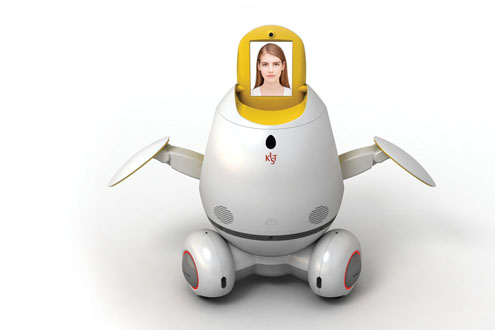
Engkey, short for English Jockey, is a 3.3-foot tall, egg-shaped machine that comes in two models — an avatar and an autonomous unit. The avatar, or telepresence type, is operated remotely by a teacher in the Philippines, whose voice, facial expressions and body movements are all communicated through Engkey.

The autonomous type teaches on its own by leading students through a preprogrammed curriculum, including songs, role-play and pronunciation exercises. It employs user tracking and voice recognition to interact with students and evaluate their performance.

As part of the recently completed pilot programs, both types of Engkey were tested at 23 elementary schools around southeastern Korea. Daegu City, home to 21 of the pilot schools, reported high satisfaction levels from both parents and students, according to the Daegu Metropolitan Office of Education.

“Engkey is a wonderful tool to motivate young kids,” DMOE Supervisor Chang Kul Lee said, adding most students feel more comfortable talking with a robot than a flesh-and-blood person.

But it’s this non-human interaction that has some language instructors concerned. Many are doubtful Engkey will be able to prepare students for success outside the classroom.

According to Michael Valley, professor of English Communication at Munseong University, Engkey’s focus on memorization fails to teach language learners the cooperation and negotiation skills necessary to acquiring true communicative competence.

“Both the telepresence and the autonomous robots deprive the students of the sense of intimacy and authenticity that a human instructor provides,” Valley said.

While Engkey proponents admit the robots should not replace humans, they do believe they will benefit remote and rural schools that struggle to recruit native English teachers.

Lee said he’s looking forward to exploring the possibilities of Engkey, but added “when it comes to teaching language, the human being is best.”

While that may be true, Engkey will never ask for a pay raise, or improved benefits, or appreciate the gift of an apple.

Ann Babe is an ESL teacher and writer who currently lives in South Korea. Photo courtesy of Center for Intelligent Robots, KIST

Peace Corps

Online Magazine

State Dept

Quick Links

The World As We Speak

Texas Introduces House Bill to adopt Seal of Bilingualism and Biliteracy
If approved, seal could appear on diplomas as early as the 2013-2014 school year

Brazilian Literature Goes Global
Reading Brazil Digitally and in Translation.

NY Becomes 2nd State to Recognize Biliterate Grads

Feds Face Foreign Language Crisis
Senate hearing discussed how the lack of adequately trained language specialists compromises national security.

State Dept Chooses Kindle for Worldwide English
In an effort to promote English literacy around the world, the U.S. Department of State is planning to purchase up to 35,000 Kindle e-readers as well as selected content. The Kindles would be distributed to U.S.-friendly educational centers around the world so as to be available to those looking to study English and learn about America.

Need for Bilingual Preschools
A new report from the Center for American Progress that urges policymakers to maximize on the investments being made in public preschool programs to serve disadvantaged children. Specifically, the report calls for "more federal, state, and local capacity to meet the increasing demand for culturally and linguistically appropriate services for children who are dual-language learners."

Tensions in Kyrgyzstan over Exams in Uzbek
Nationalists protest the availability of university entrance exams in the Uzbek language.

Linguistic Diversity Linked to Biodiversity
Linguistic and cultural preservation may be the key to protecting biodiversity.

English Proficiency Biggest Hurdle for Brazilian Scholars
At a time when Brazilians have more resources and opportunities to study abroad than ever, lacking language skills a hinderance.

Cajoling All Teachers to Consider ELLs
New report examines how to prepare teachers for the fastest growing student population in the U.S.

Language Education Cuts Compromise National Security
New Council on Foreign Relations report calls education a national security issue

Canada Instates Language Tests for Some Immigrants
Exams on proficiency in either English or French will be stated for certain immigrants in June

San Jose School Hosts Spanish Spelling Bee
First Spanish spelling bee in northern California held at a dual language academy

English is Number One Language Test in Georgia
Students in final year of school aim to take English instead of Russian in foreign language exam

Promotion of French Language is Hot Topic
The separatist opposition party in Quebec rallys for French

U.S. Demand for Portuguese Increasing
Universities scramble to keep up with influx of learners

Urdu Gets Official Status Around India
Urdu to become a language of instruction in Muslim communities

Norwegian Language Camp to be Launched
Camp will focus on Norwegian language and cultural immersion activities

National Center for Family Literacy Ruminates on Education Policy at Conference
Conference of educators, advocates, and policy makers highlights family literacy

New Arabic Center Symbolizes Chinese-Emirati Exchange
Beijing's University of Foreign Studies unveils remodeled center for Arabic language and Islamic studies.

Promoting French in Pakistan
After an exodus of native French teachers, France pushes its language and culture in Pakistan.

Columbia’s Teacher College Addresses International Education with TEDx
Inaugural TEDx conference on international education takes places

Irish Language on the Rise, but not in Ireland
Could heritage learners abroad save Irish?

Santorum: Puerto Ricans Should Learn English
While visiting Puerto Rico, Santorum turns off Boricua voters.

International Summit on Teaching Profession Takes Place in New York
Delegations from 23 countries and regions discuss education issues at the second annual summit

Journey to Find Indigenous Languages in Trip of the Tongue
New book by Elizabeth Little covers indigenous languages throughout the United States


International Portuguese educators come together to teach Timorese teachers

Read Across America Kicks Off March 2
Students all over the U.S. will celebrate literacy on Dr. Seuss's birthday

Equatorial Guinea Strengthens Connection to Portuguese
Portuguese linguists to document archaic dialect from the Annobón province.

To read from The World As We Speak Archive, click here.

Join our forum!

Find Your University

USAEducationGuides.com is a fully interactive College Search Tool that provides you with a wealth of information about 5,044 two- and four-year colleges and universities in the United States. The search includes statistics, photos, online applications, and firsthand information written by current students just like you. You can search by region, state, major, and school type to find the college of your choice.
Banner Campaign