




ETS

April 2009

by Editor | April 25th, 2009

Making Dreams Come True
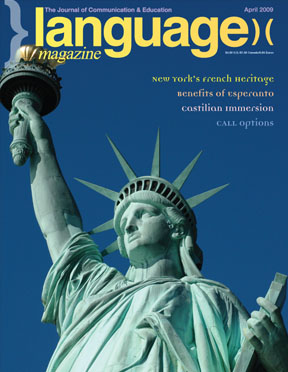
Cover April 2009

Two educational bills were re-introduced to Congress last month — The Development, Relief and Education for Alien Minors (DREAM) Act and The Educational Opportunity and Equity Commission Act (see News p.10) — which deserve the support of our representatives.

Every year, American high schools grant diplomas to 65,000 immigrant students who were brought to this country at a young age. Many of these youth have attended U.S. schools for most of their lives, but their immigration status bars them from opportunities that make a college education affordable, including in-state tuition rates, loans and grants, most private scholarships, and the ability to work legally. Despite their long-term residence in the U.S., these students are unable to further their educational accomplishments or fully contribute to the only country they know and call home.

Under the provisions of the DREAM Act, undocumented young people could be eligible for a conditional path to citizenship in exchange for a mandatory two year commitment in higher education or the military. Undocumented young people must also demonstrate good moral character to be eligible for and stay in conditional residency. At the end of the long process, the young person can have the chance to become an American citizen.

It has been eight years since the DREAM Act was first introduced to Congress in 2001, during which thousands of bright students have had their ambitions dashed through no fault of their own but due to their inherited status. Not only is it immoral to discriminate against these children, it is impractical — all the evidence shows that college graduates are far more likely to be net contributors to their society than those denied the opportunity.

The Educational Opportunity and Equity Commission Act is only the very first step towards the creation of a more equitable funding structure for public education, but it is a welcome step nonetheless. Never has the inequity of school funding been more apparent than during the current distribution of stimulus package monies. In its allocation of cash to states and school districts, the federal government is relying on traditional formulas, some of which benefit states that spend more per pupil, while others help states with large concentrations of poor students or simply direct money based on population figures. One thing the formulas seem unable to determine is where the money is most needed. As a result, some districts that are relatively rich are receiving more funds than others that are struggling. For example, North Dakota, which has no budget problems, will receive $1,734 per student whereas California, which recently made deep educational spending cuts, will only get $1,336. Utah, where deep school cuts are on the cards, will get $1,250 per student, while Wyoming, with no deficit, will get $1,684.

The education secretary and other politicians are aware of the disparities but argue that it would take too long to come up with a more equitable formula.
Both of these bills are being re-introduced to Congress during an economic crisis when there are other priorities, but the reality is that we would be in a better position now if these bills had been passed when they were first introduced.

Let’s start working on legislation now that will reinforce our education system, distribute funds fairly, and provide opportunities for all students to succeed.

P.S. Visit our new online forum to discuss topics like this, ask for expert assistance, share teaching tips, meet fellow linguists, and voice your opinions on all things linguistic at www.languagemagazine.com/forum.

IN THIS ISSUE:

The World as We Speak

Our forum for changes in world language

Who Knows Where Esperanto Might Lead?
Robert L. Read and Steven D. Brewer explain how Esperanto acts as a springboard for the acquisition of other languages

Lady Liberté Shares Her French Heritage
David Lasserre describes how a non-profit program is helping young New Yorkers retain their French flavor

CALL Update
Language Magazine’s selection of the latest in language and literacy technology

Castilian at Its Source
Kate Sommers-Dawes finds that there’s nothing plain
about Spain’s central meseta

Reviews

Last Writes
Richard Lederer
starts his new Teacher Topics series

Plus all the latest news in language learning technology, book reviews, and source information on language funding

Leave a Reply

Banner Campaign
Banner Campaign

Excellence and Innovation in Language Learning Act

Reps. Rush Holt (D-NJ) and Paul Tonko (D-NY) have introduced the Excellence and Innovation in Language Learning Act (HR 6036), a bill that would authorize $400 million in funding for FY 2011 for the teaching of foreign languages to K-12 students. The sponsoring Representatives hope that the bill will become part of the reauthorization of the Elementary and Secondary Education Act, or “No Child Left Behind.” Tonko spoke about his intention to introduce this bill two weeks ago at a policy briefing on language learning in the global age: “The next generation must not follow the globe, but shape it,” Tonko said, noting that foreign language instruction for young Americans is imperative to “U.S. national security and global leadership challenges.” Key elements of the bill are that it would authorize $400 million for fiscal year 2011 for programs at the national, state, and local levels, specifically: a. National activities: $100 milion to establish the U.S. Department of Education in a leadership role to coordinate a national effort to build our language capacity by supervising the adoption of standards, supporting research for best practice in teaching languages, collecting data on international benchmarks in language learning, providing scholarships for students and teachers to study abroad, and support partnerships that demonstrate high quality and effective models of language instruction. b. State Activities: $100 million to help establish a statewide coordination advisory council that would develop a comprehensive state plan for expanding language learning opportunities as well as boosting efforts to recruit and train qualified language teachers. c. Foreign Language Education Partnership Programs: $200 million for partnerships between K-12 school systems and higher education to develop model K-16 sequences of language instruction that would include appropriate assessments of language proficiency and provide scholarships for teachers and students as well as fund research on effective language teaching. Please contact your representatives to express your support for this bill.

Defense Department Funds Translation Technology

BBN Technologies, a subsidiary of defense giant Raytheon Company, has been granted 6.1 million dollars in funding for its Multilingual Automatic Document Classification, Analysis and Translation (MADCAT) program. The additional monies come from the Defense Advanced Research Projects Agency, or DARPA, which is the research and development arm for the Department of Defense. MADCAT runs on a laptop and immediately translates written text in almost any form (including handwritten notes) without the use of a translator. As Prem Natarajan, BBN's top employee in speech and language processing said in a press release, "Foreign language translation on the battlefield is slow, dangerous and expensive. The MADCAT system will help our troops understand road signs, print media and captured documents that could be of immediate importance to their safety and to the successful completion of their missions."

Hispanic Theatre Festival Honors Mexico

Taking place through August 1 in Miami, the International Hispanic Theatre Festival is celebrating both its 25th year and Mexico's contribution to Latin American culture. Mexican actor and director Maestro José “Pepe” Solé will receive a Lifetime Achievement in the Performing Arts Award. Also descending upon Miami to showcase their work are artists from Mexico, Brazil, Argentina, Uruguay, Chile, Spain and Puerto Rico. Said Mario Ernesto Sánchez, whose theater, Teatro Avante, hosts the festival; “It amazes me that it has been 25 years. It has always been a struggle for audiences, for funding, for success, for everything you dream of."

NYTimes Advocates for Educational Civil Rights

The editorial board of the New York Times has urged the White House to support the Department of Education Office for Civil Rights compliance reviews despite anticipated push back from districts. See the editorial here: http://www.nytimes.com/2010/03/16/opinion/16tue2.html?hp. More on how this will affect English Language Learners in April's issue of Language Magazine.
Join our forum!

Find Your University

USAEducationGuides.com is a fully interactive College Search Tool that provides you with a wealth of information about 5,044 two- and four-year colleges and universities in the United States. The search includes statistics, photos, online applications, and firsthand information written by current students just like you. You can search by region, state, major, and school type to find the college of your choice.