




ETS

August 2010

by admin34 | July 30th, 2010

Keeping Up With Styles
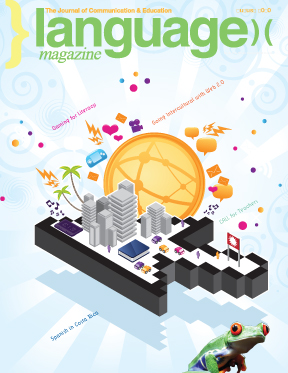
August 2010 Cover
As educational spending budgets are squeezed, the return on investment in educational technology is also coming under increased scrutiny. We cut such spending at our peril. Of course, we must invest in books and teachers but technology offers students more opportunity to learn according to their own style. Since the earliest language labs with reel-to-reel tape recorders, technology has been an integral part of language education.

For good reason. Language, both first and second, acquisition in particular is accelerated by the multimedia channels made available through new technology. Now, we are also starting to appreciate the opportunities it offers for differentiated instruction to cater not only to multi-level classes but also to individual learning styles.In his 1983 book Frames of Mind, Harvard professor Howard Gardner originally identified seven intelligences (or learning styles) that we all possess, to which three new intelligences have recently been added. Because our understanding of the brain and human behavior is constantly evolving, the number of intelligences is expanding. Gardner claims that we all have all the intelligences, but that no two people are exactly alike and by understanding a student’s strengths and weaknesses in each intelligence, we can help students become more successful. He adds that integrating multiple intelligences into the classroom requires addressing individual differences and providing a range of activities and experiences to facilitate learning. Technology can be used to facilitate learning in each intelligence area. The key is to provide the most suitable learning environment for students according to their particular  balance of intelligences or styles.

A couple of years ago, Gardner clarified his position on technology’s effect on literacy, “At the start of the 21st century, there’s a dizzying set of literacies available — written languages, graphic displays and notations. And there’s an even broader array of media — analog, digital, electronic, hand-held, tangible and virtual — from which to pick and choose… I don’t worry for a nanosecond that reading and writing will disappear. Even in the new digital media, it’s essential to be able to read and write fluently… I also question the predicted disappearance of the material book… The convenience and portability of the book aren’t easily replaced.” (“The End of Literacy? Don’t Stop Reading” printed in the Washington Post, February 17, 2008.)

Investing in technology does not preclude support for more traditional means of education like books, libraries, and librarians. Gardner’s position and research by other pioneers like Dr. Rita Dunn shows us that the wider the range of teaching methods and materials available the more likely students are to find the methodology that suits their particular style or intelligence. To best serve the array of learners in our schools we must retain the tools which work while embracing and experimenting with new teaching formats that reflect our society’s development.

As John Dewey, the 20th century philosopher and educational reformer said “If we teach today as we taught yesterday, we rob our children of tomorrow.”

IN THIS ISSUE:

Insuring Adventure

Harnessing Technology
Lance Knowles recommends educators train to use technology to improve language learning efficacy

Weaving Culture into the Web
Fred Dervin explores how teachers can use the Living Web (Web 2.0) for intercultural education in language learning and teaching

Video Gaming: The New Free Voluntary Reading?
Kenneth S. Horowitz finds a parallel between the use of video games and Krashen’s theories of Free Voluntary Reading and Free Voluntary Surfing

Experimenting with Technology
Language Magazine Product Review of Language Labs

Pura Vida Española

Kate Sommers-Dawes marvels at Costa Rica

as a Spanish immersion destination

Last Writes
Richard Lederer has a dictionary for teachers

Plus all the latest news in language learning technology, book reviews, and source information on language funding

5 Responses to “August 2010”

  1. I thoroughly agree with the importance of differentation in catering for all types of learners. Today’s technology allows teachers to build this very effectively into their teaching.
    The John Dewey quotation should not be ignored “If we teach today as we taught yesterday, we rob our children of tomorrow.”

  2. Yes… technology very usefull and very effective

  3. Katie Chandler says:

    Students entering my language classroom often bring with them a myriad of technological toys, frowned upon by some teachers, encouraged and celebrated by me! Together we explore ways of using these technologies to better understand the world we live in. We are constantly looking for ways new technologies can enhance our learning of languages and understanding of culture. Language learning is simply buzzing in my room!

Leave a Reply

Banner Campaign
Banner Campaign

Excellence and Innovation in Language Learning Act

Reps. Rush Holt (D-NJ) and Paul Tonko (D-NY) have introduced the Excellence and Innovation in Language Learning Act (HR 6036), a bill that would authorize $400 million in funding for FY 2011 for the teaching of foreign languages to K-12 students. The sponsoring Representatives hope that the bill will become part of the reauthorization of the Elementary and Secondary Education Act, or “No Child Left Behind.” Tonko spoke about his intention to introduce this bill two weeks ago at a policy briefing on language learning in the global age: “The next generation must not follow the globe, but shape it,” Tonko said, noting that foreign language instruction for young Americans is imperative to “U.S. national security and global leadership challenges.” Key elements of the bill are that it would authorize $400 million for fiscal year 2011 for programs at the national, state, and local levels, specifically: a. National activities: $100 milion to establish the U.S. Department of Education in a leadership role to coordinate a national effort to build our language capacity by supervising the adoption of standards, supporting research for best practice in teaching languages, collecting data on international benchmarks in language learning, providing scholarships for students and teachers to study abroad, and support partnerships that demonstrate high quality and effective models of language instruction. b. State Activities: $100 million to help establish a statewide coordination advisory council that would develop a comprehensive state plan for expanding language learning opportunities as well as boosting efforts to recruit and train qualified language teachers. c. Foreign Language Education Partnership Programs: $200 million for partnerships between K-12 school systems and higher education to develop model K-16 sequences of language instruction that would include appropriate assessments of language proficiency and provide scholarships for teachers and students as well as fund research on effective language teaching. Please contact your representatives to express your support for this bill.

Defense Department Funds Translation Technology

BBN Technologies, a subsidiary of defense giant Raytheon Company, has been granted 6.1 million dollars in funding for its Multilingual Automatic Document Classification, Analysis and Translation (MADCAT) program. The additional monies come from the Defense Advanced Research Projects Agency, or DARPA, which is the research and development arm for the Department of Defense. MADCAT runs on a laptop and immediately translates written text in almost any form (including handwritten notes) without the use of a translator. As Prem Natarajan, BBN's top employee in speech and language processing said in a press release, "Foreign language translation on the battlefield is slow, dangerous and expensive. The MADCAT system will help our troops understand road signs, print media and captured documents that could be of immediate importance to their safety and to the successful completion of their missions."

Hispanic Theatre Festival Honors Mexico

Taking place through August 1 in Miami, the International Hispanic Theatre Festival is celebrating both its 25th year and Mexico's contribution to Latin American culture. Mexican actor and director Maestro José “Pepe” Solé will receive a Lifetime Achievement in the Performing Arts Award. Also descending upon Miami to showcase their work are artists from Mexico, Brazil, Argentina, Uruguay, Chile, Spain and Puerto Rico. Said Mario Ernesto Sánchez, whose theater, Teatro Avante, hosts the festival; “It amazes me that it has been 25 years. It has always been a struggle for audiences, for funding, for success, for everything you dream of."

NYTimes Advocates for Educational Civil Rights

The editorial board of the New York Times has urged the White House to support the Department of Education Office for Civil Rights compliance reviews despite anticipated push back from districts. See the editorial here: http://www.nytimes.com/2010/03/16/opinion/16tue2.html?hp. More on how this will affect English Language Learners in April's issue of Language Magazine.
Join our forum!

Find Your University

USAEducationGuides.com is a fully interactive College Search Tool that provides you with a wealth of information about 5,044 two- and four-year colleges and universities in the United States. The search includes statistics, photos, online applications, and firsthand information written by current students just like you. You can search by region, state, major, and school type to find the college of your choice.